After your visit: care instructions
These instructions cover the first days after common treatments at Precision Dental of Windsor. If anything here does not match what you were told at your visit, follow what you were told and call us with questions. Our number is (970) 237-4313.
When to get emergency help: Call 911 or go to the nearest emergency department if you have trouble breathing or swallowing, swelling that is spreading or affecting your throat, or bleeding that will not stop after 20 to 30 minutes of firm pressure. Keep pressure on bleeding while you get help. For urgent problems that are not emergencies, call us at (970) 237-4313.
- After a filling
- After a crown
- KöR Whitening
- Opalescence Whitening
- After scaling and root planing (deep cleaning)
- Nightguard care
After a filling
While you are numb
Do not eat until the numbness wears off. Numbness usually lasts 1 to 3 hours. Biting your lip, cheek, or tongue while numb can cause real injury, and it is easy to do without feeling it. For what to expect from the numbing itself, see Getting Numb at the Dentist: What to Expect.
Eating
Your filling is fully set when you leave. You can chew on it once the numbness is gone. Start with softer foods the first day if the tooth feels tender.
What is normal
Some sensitivity to cold, heat, or pressure is normal for a few days and can last a few weeks, especially after a deep filling. Mild soreness in the jaw and tenderness where the injection was given are also normal.
Call us if
- Your bite feels high, like one tooth hits first when you close. This is a simple adjustment.
- Your symptoms worsen over time instead of improving.
- Your sensitivity or pain is not controlled with over-the-counter pain medication.
Care
Brush and floss normally. Be gentle around the new filling the first day.
If you wear a nightguard, retainer, or partial denture, bring it to your filling appointments, so we can check that it fits correctly with the new filling and clean it professionally.
Further reading: Toothpaste, Mouth Rinse, and Floss: How Common Products Compare With ADA Recommendations
After a crown
While you have a temporary crown
Your temporary crown protects the tooth while the lab makes your permanent crown. It is held on with temporary cement and can come loose.
- Chew on the other side when you can. Avoid sticky foods (caramel, gum, taffy) and hard foods on the temporary.
- When you floss around the temporary, slide the floss out to the side instead of pulling it up. Pulling up can lift the temporary off.
- If the temporary comes off, call us. If it is after hours and the tooth is not painful, you can put the temporary back on with a small amount of temporary dental cement or denture adhesive from a pharmacy until we can see you. Do not use household glue.
- Mild sensitivity and sore gums around the temporary are normal.
After your permanent crown is cemented
- Do not eat until the numbness wears off.
- The crown is set when you leave, but avoid very hard or sticky foods on it for the first 24 hours.
- Some sensitivity to temperature or pressure is normal for a few days and can last a few weeks.
- Brush and floss normally, including around the crown. The gumline around a crown needs the same daily cleaning as any tooth.
For what to expect from the numbing itself, see Getting Numb at the Dentist: What to Expect.
Call us if
- Your bite feels high or uneven.
- The crown feels loose.
- Your symptoms worsen over time instead of improving.
- Your sensitivity or pain is not controlled with over-the-counter pain medication.
If you wear a nightguard, retainer, or partial denture, bring it to your crown appointments, so we can check that it fits correctly with the new crown and clean it professionally.
Further reading: I'm Getting a Crown, Will I Need a Root Canal Too?
KöR Whitening
We offer KöR in two forms: KöR-Night, worn while you sleep, and KöR-Day, worn while you are awake. These instructions follow KöR's own patient instructions for each system. Your kit includes syringes of KöR whitening gel and a bottle of KöR Teeth Desensitizer. Do not use whitening gel if you are pregnant.
KöR-Night
The schedule
- Wear your trays while you sleep for a minimum of 14 nights in a row. Do not skip nights. Skipping slows the process and reduces the final result.
- Using KöR-Night for more than 14 nights is only under our supervision. We will tell you if your teeth need additional nights.
- If you have an in-office whitening visit scheduled, keep whitening every night until that visit. Bring your trays and your entire kit with you to the visit. After the in-office visit, continue nightly whitening until your gel is used up.
- Put your trays in immediately before sleep. Do not read or watch television with the trays in.
Each night
- Brush your teeth right before whitening.
- Apply the desensitizer before whitening, every night. Wash your hands first. Put drops of desensitizer on one cotton swab from the kit until it is fully wet but not dripping. Work one corner of your mouth at a time: pull the cheek and lip away from the teeth, dry the teeth with a cloth or paper towel, and scrub the desensitizer firmly into the sides of the teeth, with extra emphasis next to the gumline and on the biting edges of the front teeth. Skip the second molars, the teeth farthest back. When all four corners are done, rinse gently with water. The swabs in the kit are only for desensitizer. Do not use them for anything else.
- Fill the trays. Squeeze a dab of gel into each tooth space, on the inner side of the outer wall of the tray, except the very last molars.
- Seat the trays and seal them. Push the trays firmly onto your teeth, then gently push the edges back against the teeth until they contact the teeth next to the gumline. A little gel should squeeze out at the edge. A large amount means the tray was overfilled; use less the next night. No gel squeezing out means use a little more the next night.
Each morning
- Remove the trays, rinse your mouth with water, and brush your teeth.
- Apply the desensitizer the same way as above, every morning, including the first two mornings.
- Clean the trays with cool tap water using a cotton swab in a rotating motion (not the swabs from your kit). Do not use warm or hot water. Shake the water off. If you will wear the trays again that night, leave the case open so they dry fully.
KöR-Day
The schedule
- Wear your trays while you are awake, once or twice a day, until the gel in your kit is gone. Do not skip days. Consecutive daily whitening gives the best result.
- Wear the trays 30 to 60 minutes each time. If you have little or no sensitivity, wear them for 60 minutes. If your teeth feel sensitive, wear them for 30 minutes or less.
- If you have an in-office whitening visit scheduled, keep whitening every day until that visit.
- Using KöR-Day for more than 14 days is only under our supervision. Ask us before continuing past two weeks.
Each session
- Brush your teeth right before whitening.
- Apply the desensitizer before whitening. Wash your hands first. Put drops of desensitizer on one cotton swab from the kit until it is fully wet but not dripping. Work one corner of your mouth at a time: pull the cheek and lip away from the teeth, dry the teeth with a cloth or paper towel, and scrub the desensitizer firmly into the sides of the teeth, with extra emphasis next to the gumline and on the biting edges of the front teeth. Skip the second molars, the teeth farthest back. When all four corners are done, rinse gently with water. The swabs in the kit are only for desensitizer.
- Fill the trays. Squeeze a dab of gel into each tooth space, on the inner side of the outer wall of the tray, except the second molars.
- Seat the trays and seal them. Push the trays firmly onto your teeth, then gently push the edges back against the teeth until they contact the teeth next to the gumline. A little gel should squeeze out at the edge. A large amount means the tray was overfilled; use less next time. No gel squeezing out means use a little more next time.
After each session
- Remove the trays and rinse your mouth. Do not swallow the gel or the rinse water.
- Clean the trays under cool tap water with a cotton swab (not the swabs from your kit). Do not use warm or hot water. Shake the water off. If you will wear the trays again within 12 hours, leave the case open so they dry. Otherwise close the case.
- Brush your teeth, then apply the desensitizer again, the same way as before whitening.
Gel and tray care
- Keep the gel syringes in the refrigerator. Gel is damaged by heat. Never leave your kit in a hot car.
- Store the trays loose in their case, away from heat. Heat distorts them. Do not wash them in warm or hot water. Keep them away from dogs.
Food and drink
During whitening, and for a couple of days after, avoid foods and drinks that stain. A useful test: if it would permanently stain a white shirt, avoid it. Reduce smoking as much as possible during whitening.
What to expect
- Slight gum soreness and slight tooth sensitivity are normal. If sensitivity is more than slight, call us.
- If your gums or mouth become red, swollen, or sore, stop whitening and call us.
- Avoid swallowing the gel, and the water you rinse with after removing your trays.
- Teeth can look uneven during treatment: white spots, a darker look near the gumline, or a chalky look. This is normal and evens out a week or two after you finish.
- Lower teeth often whiten more slowly than upper teeth. If they are noticeably behind at the end, we may have you wear the trays on the lower teeth for one more week.
Keeping the result
Whitened teeth darken again over time without maintenance. Wear your trays periodically as we direct for your teeth. Maintenance kits are available from our office.
Further reading: How sensitivity toothpaste works · Whitening toothpaste versus bleaching
Opalescence Whitening (take-home trays)
Using your trays
- Brush and floss before putting your trays in.
- Place a small drop of gel in the front of each tooth space in the tray, about a third to a half of a syringe per arch. More gel does not whiten faster. Wipe off any gel that squeezes onto your gums.
- Wear the trays for the time that matches your gel strength: 10% for 8 to 10 hours, or overnight; 15% for 4 to 6 hours; 20% for 2 to 4 hours; 35% for 30 to 60 minutes.
- Do not eat or drink while the trays are in.
- After removing the trays, brush your teeth and rinse the trays with cool water. Store them in their case, away from heat.
During treatment
- Avoid coffee, tea, red wine, berries, and other dark foods and drinks during the whitening period and for 48 hours after your last session.
- Sensitivity is common. Toothpaste for sensitive teeth helps. Stop whitening and call us if discomfort is more than mild, persists, or worsens. Resume only as directed.
- Do not use whitening gel if you are pregnant or nursing.
- Avoid swallowing large amounts of gel. Small amounts swallowed during normal use are expected.
- Store gel in a cool place. Do not use gel past its expiration date.
Call us if
- A tray cracks or no longer fits.
- Your gums blister or stay sore.
- Discomfort is more than mild, persists, or worsens.
Further reading: How sensitivity toothpaste works · Whitening toothpaste versus bleaching
After scaling and root planing (deep cleaning)
While you are numb
Do not eat until the numbness wears off. You could bite your lip, cheek, or tongue and cause damage. For what to expect from the numbing itself, see Getting Numb at the Dentist: What to Expect.
Pain relief
Most people have some discomfort when the anesthesia wears off. Use one of the following, not both at the same time unless we direct it.
- Ibuprofen (Advil): 600 mg (3 over-the-counter tablets) every 6 hours as needed. Do not take more than 2,400 mg in 24 hours. Take it with food. Do not use ibuprofen if you take a blood thinner, have kidney disease or a stomach ulcer, are pregnant, or have been told to avoid it.
- Acetaminophen (Extra Strength Tylenol): 1,000 mg (2 tablets) every 6 hours as needed. Do not take more than 3,000 mg in 24 hours. This limit includes acetaminophen in other medicines, such as cold and flu products. Avoid alcohol while taking it regularly.
Swelling
Slight swelling is not unusual. A cold pack or a bag of frozen vegetables wrapped in a soft towel, held on the cheek over the area for 20 minutes on and 20 minutes off, helps during the first 24 hours.
Sensitivity
Teeth are often sensitive to cold after deep cleaning. This usually decreases over several weeks. Keeping plaque off the teeth helps it settle faster. If sensitivity is extreme, call us.
Bleeding
A pink tinge to your saliva is normal for the first 48 hours. If bleeding continues, bite on moist gauze or a moist tea bag with light pressure for 20 to 30 minutes. If bleeding does not slow down after 20 to 30 minutes of pressure, call us right away. Do not wait for the 48-hour mark with bleeding that will not stop. If bleeding increases or continues past 48 hours, call us the same day.
Eating
Eat as tolerated once the numbness is gone. Soft foods are best the first day: soup, pasta, scrambled eggs, mashed potatoes, macaroni and cheese. Avoid hard foods (ice, nuts, popcorn, chips), sticky foods, spicy foods, and acidic foods for the first few days. Drink plenty of fluids and eat normally enough to support healing.
Home care
- Starting the evening of treatment, rinse gently. From the next day, rinse 2 to 3 times a day with warm salt water (half a teaspoon of salt in an 8-ounce glass of warm water) or your regular mouth rinse. Do not rinse or spit hard for the first 24 hours.
- Brush gently but thoroughly, starting the first evening. Mild bleeding during brushing is normal for a few days.
- Keep up your daily cleaning, including between the teeth, as we showed you.
Smoking
Do not smoke for 7 to 14 days after treatment. Smoking delays gum healing. Please consider quitting for good.
Your follow-up
Your next visit is a periodontal maintenance appointment about 4 to 6 weeks after treatment. At that visit we measure your gums again to check how they healed, and clean below the gumline as needed. After that, periodontal maintenance continues on a regular schedule, usually every 3 months. These visits are part of the treatment, not an extra.
Call us if
- Bleeding continues past 48 hours.
- Your symptoms worsen over time instead of improving. This includes pain or swelling that increases after the first 2 days.
- Your sensitivity or pain is not controlled with over-the-counter pain medication.
- You have a fever.
Further reading: Bone Loss Around Teeth: Why Age Alone Doesn't Explain It · Water Flosser or String Floss: What the Evidence Shows · Why Does My Calculus Seem to Build Up Faster Than My Friends and Family?
Nightguard care
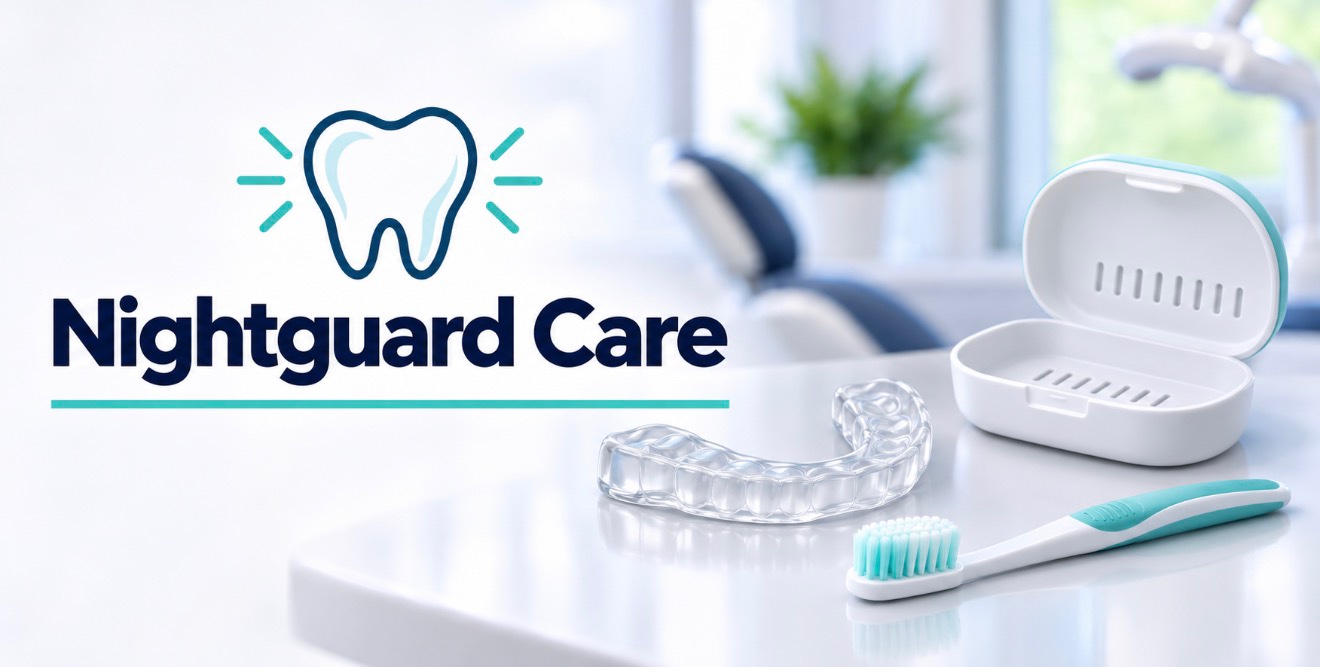
Our nightguards are made from Ultraflex, a flexible material. The cleaning instructions below are for that material. Flexible guards are cleaned differently from hard acrylic guards.
Wearing it
- Wear your nightguard every night while you sleep, or as we directed. Put it in after brushing and flossing.
- Seat it with gentle finger pressure. It should fit snugly and cover the teeth it was made for.
- Your bite may feel briefly unfamiliar when you take the guard out in the morning. If your bite stays different, your teeth no longer meet normally, or the change comes with pain, stop wearing the guard and call us.
Cleaning it
- Rinse the guard with cool water when you take it out in the morning.
- Brush it gently every day with a soft toothbrush and a small amount of mild liquid soap, then rinse well. Do not use toothpaste. Toothpaste is abrasive and scratches the surface, and scratches hold bacteria and odor.
- Do not soak your guard in denture cleaner, retainer cleaner, mouthwash, or any other cleaning solution unless we tell you to. Soaking products made for hard guards can damage flexible material.
- Never use hot water on your guard. Heat warps the material and ruins the fit.
- Let the guard dry, and store it in the case we gave you. Wash the case regularly with soap and water, and let it dry.
Protecting it
- Keep the guard in its case and away from pets. Dogs chew nightguards.
- Keep it away from heat, including a hot car.
- Bring your nightguard to every filling and crown appointment and to every cleaning appointment, so we can clean it professionally and check its fit and condition.
Call us if
- It causes new or worsening tooth or jaw pain. Stop wearing the guard and call us.
- Your bite stays different after you take the guard out, as described above. Stop wearing the guard and call us.
- It cracks, breaks, or is damaged in any way. Do not wear a damaged guard, and do not try to trim or repair it at home. Call us so we can check it.
- It feels loose, rocks, or no longer seats fully. Do not force it. Call us so we can check it.
- You lose it. Call promptly, and we will arrange a replacement.
Questions about your care? Call Precision Dental of Windsor at (970) 237-4313, and let's talk.