Water Flosser or String Floss: What the Evidence Shows
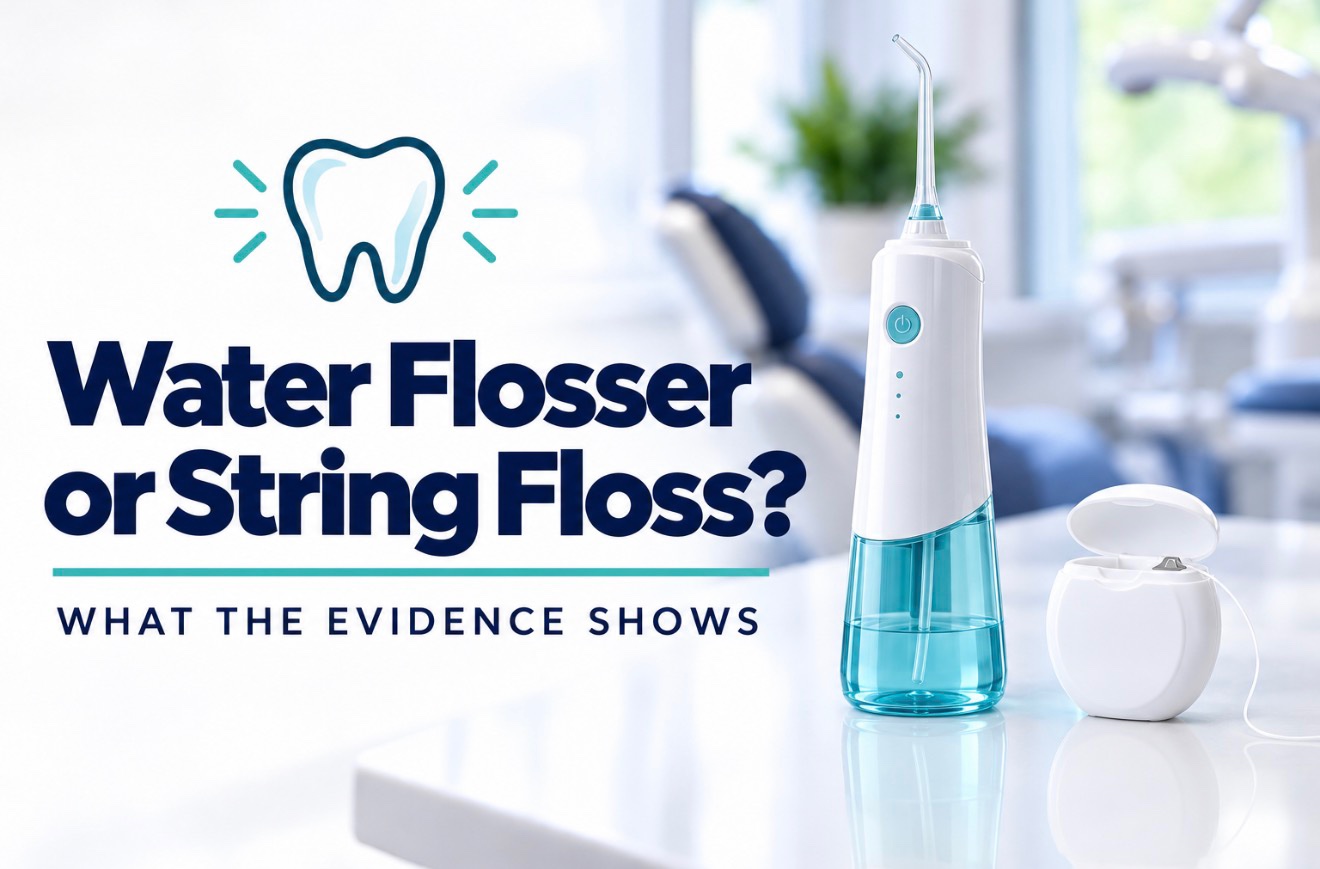
Patients often ask whether a water flosser can take the place of string floss. The short answer is that the ADA accepts either one. The ADA recommends cleaning between the teeth once a day with floss or with another interdental cleaner. [1][2] The better question is which tool fits your mouth and your habits, because the evidence does not name a winner for every patient.
How each one cleans
String floss cleans by contact. The floss passes through the contact point between two teeth and is pressed against the side of each tooth, where it scrapes off plaque as it moves up and down. It reaches the exact surfaces where two teeth touch, which a brush cannot reach.
A water flosser cleans by flushing. The device sends a pulsed stream of water between the teeth and along the gumline. The stream removes food and loose debris and disrupts plaque in places a thread cannot easily reach, such as around braces and under a fixed bridge. It does not scrape the side of a tooth the way floss does. The two tools clean by different actions, which is why studies comparing them do not all point the same way.
Does it replace string floss?
A water flosser can be an alternative for daily interdental cleaning; the right choice depends on your mouth and technique. The ADA recommendation is to clean between the teeth once a day with floss or another interdental cleaner, and a water flosser is one of the cleaners the ADA lists. Water flossers that carry the ADA Seal have been shown to be safe and effective at removing plaque and reducing gingivitis. [2] A patient who will use a water flosser every day and will not use string floss is better served by the water flosser.
Three qualifications belong with that answer. First, replacement is a statement about the daily recommendation, not proof that the two tools are equal on every measure: the trial findings on plaque vary, and the trials in the Cochrane review did not measure cavities between the teeth. [3] Second, some sites still need contact cleaning or a different tool: floss scrapes tight contacts, and for wider spaces an appropriately sized interdental brush may be a good choice. Third, a water flosser does not replace brushing, and for patients with periodontal disease it is an addition to professional treatment, not a substitute for it.
What the comparison studies found
The largest summary is a Cochrane review of 35 randomized trials with 3,929 adults. [3] Its findings, stated with the review’s own certainty ratings:
- Floss added to toothbrushing may reduce gingivitis at one, three, and six months, compared with toothbrushing alone. The certainty of the evidence was low, and the effect on plaque was inconsistent.
- A water flosser added to toothbrushing may reduce gingivitis at one month, but the effect was not seen at three or six months. The certainty of the evidence was very low. The review found no added reduction in plaque or in bleeding sites from the water flosser over toothbrushing alone.
- In the trials that compared the two directly, a water flosser may reduce gingivitis more than floss at one month, with no difference in plaque removal. The certainty of that evidence was low to very low.
- The reviewers noted that the effects seen across these studies may not be large enough to be clinically important, and that many participants had little gum inflammation when the studies started.
- The trials in this review did not measure cavities between the teeth, so the review does not answer which tool prevents more cavities.
- Trials that recorded side effects found no serious adverse events from either tool, and no difference between groups in minor effects such as gum irritation.
Individual trials are smaller and shorter, and several of them favor the water flosser more strongly. In a four-week trial of 105 adults with gingivitis, a pulsating water flosser reduced bleeding, gingivitis scores, and plaque scores more than waxed string floss. [4] That trial received support from the device manufacturer, and its first author was a manufacturer employee during the study. It was also small and short, 105 participants over four weeks, and it is read here alongside the review evidence rather than on its own. A 2025 systematic review and meta-analysis examined 18 trials and pooled 15 of them. Its short-term comparison of bleeding against floss, in patients without braces, was rated moderate certainty and favored the water flosser. Its results for plaque and gingivitis varied across comparisons. [5] The fair reading of the whole record: some short-term comparisons favor water flossers for bleeding; plaque and gingivitis findings vary. The evidence is mostly short-term, and its certainty ranges from very low to moderate depending on the comparison.
When each tool may fit better
Braces. Threading floss under wires with a floss threader is slow, and many patients stop doing it. In a trial of 106 adolescents with fixed braces, a dental water jet with an orthodontic tip, used once a day with a manual toothbrush, reduced plaque and bleeding more than flossing over four weeks. [6] The study was short and limited to adolescents with braces. The 2025 systematic review did not find a significant bleeding advantage for the water flosser over floss in its four-week orthodontic comparison. [5] The case for a water flosser with braces is therefore practical as much as clinical: it is faster around brackets and wires, and a tool a patient uses every day serves them better than a tool they have given up on.
Dental work and limited hand movement. The ADA notes that water flossers can be an option for people who have trouble flossing by hand, and for people whose dental work makes flossing difficult, such as braces or permanent fixed bridges. [2] The same applies to patients with limited dexterity from arthritis or other conditions: a device that is aimed is easier to use than a thread that must be wrapped and guided.
Implants. A 2025 systematic review of seven small studies, with 360 participants, examined oral irrigators around dental implants. Some of the comparisons it included favored the water flosser for plaque, inflammation, and bleeding, including against floss at implant sites. The review was a narrative synthesis of varied studies rather than a pooled analysis, its results were not uniform, and the certainty of the evidence was rated very low. [7] This is early evidence, not a settled result.
Tight contacts. Where two teeth touch tightly and no brush fits between them, floss is the tool that reaches the contact surfaces and scrapes them. A water stream cleans around and between the teeth but does not press against the tooth side.
Cost and simplicity. Floss costs a few dollars, fits in a pocket, and needs no counter space, charging, or cleaning. A water flosser costs more, uses counter or shower space, and needs routine care: clean and dry the device as the manufacturer directs.
No device between the patient and the habit. For a patient who already flosses well and daily, the evidence gives no reason to switch.
One further tool belongs in this comparison. Where the space between the teeth is wide enough, an interdental brush is a well-supported option: the Cochrane review found that interdental brushes may reduce gingivitis more than floss, while its findings on plaque were inconsistent. [3] Many mouths need more than one tool, for example an interdental brush at the back teeth and floss at the front.
How to use each one correctly
Floss. Use about 18 inches and wrap most of it around the middle fingers. Guide it through the contact with a gentle sawing motion. Curve it into a C against one tooth, move it up and down from just under the gumline, then curve it against the neighboring tooth and repeat. Use a clean section for each space.
Water flosser. Fill the reservoir with warm water. Start on the lowest pressure setting, and follow the instructions for your device and for the tip you are using. Some tips, including the tips made for periodontal pockets, are used at the lowest setting only. Lean over the sink, place the tip in the mouth, and close the lips enough to limit splashing. With a standard jet tip, aim the tip at a 90-degree angle to the gumline, and move slowly along the gumline, pausing briefly between the teeth. Specialty tips have their own instructions; follow the directions for the tip you are using. Work the outside and inside surfaces of both arches.
Both. Clean between the teeth once a day. Bleeding in the first days of a new routine often reflects gum inflammation that was already present, and it tends to settle as cleaning becomes regular. Bleeding can also have other causes, including injury from a tool used with too much force and certain medications. If bleeding is persistent, recurrent, heavy, or concerning, contact your dentist. Bleeding that does not stop promptly needs medical attention. Neither tool replaces brushing twice a day with fluoride toothpaste, and neither replaces a periodontal assessment when gum disease is present.
Summary
| String floss | Water flosser | |
|---|---|---|
| How it cleans | Scrapes plaque from the tooth side by contact | Flushes debris and disrupts plaque with a pulsed water stream |
| Best fit | Tight contacts; patients who floss well | Braces, fixed bridges, limited dexterity, patients who will not use string floss |
| Evidence | May reduce gingivitis at 1 to 6 months added to brushing (low certainty) [3] | May reduce gingivitis at 1 month added to brushing (very low certainty); some short-term comparisons favor it for bleeding, plaque and gingivitis findings vary [3][4][5] |
| Cavities between the teeth | Not measured in the trials in this review | Not measured in the trials in this review |
| Limits | Technique-dependent; slow around braces and bridges | Cost, counter space, reservoir cleaning; does not scrape the contact surface |
Evidence matters. Individual assessment matters. If you are not sure which tool fits your teeth, bring the question to your next visit, and let’s talk.
References
- American Dental Association. Floss and Other Interdental Cleaners. Oral Health Topics. ada.org. See also MouthHealthy
- American Dental Association. Water Flossers and Water Flossing. MouthHealthy. ADA
- Worthington HV, MacDonald L, Poklepovic Pericic T, et al. Home use of interdental cleaning devices, in addition to toothbrushing, for preventing and controlling periodontal diseases and dental caries. Cochrane Database of Systematic Reviews. 2019;4:CD012018. Cochrane
- Mancinelli-Lyle D, Qaqish JG, Goyal CR, Schuller R. Efficacy of water flossing on clinical parameters of inflammation and plaque: a 4-week randomized controlled trial. International Journal of Dental Hygiene. 2023;21(4):659-668. Publisher (Manufacturer support disclosed; first author was a Water Pik employee during the study.)
- Badahdah A, et al. Alleviation of plaque and gingivitis with dental water jet in regular and orthodontic patients: a systematic review and meta-analysis. Healthcare. 2025;13(4):396. doi:10.3390/healthcare13040396. Full text
- Sharma NC, Lyle DM, Qaqish JG, Galustians J, Schuller R. Effect of a dental water jet with orthodontic tip on plaque and bleeding in adolescent patients with fixed orthodontic appliances. American Journal of Orthodontics and Dentofacial Orthopedics. 2008;133(4):565-571. DOI
- Gandhi G, et al. Efficacy of oral irrigators compared to other interdental aids for managing peri-implant diseases: a systematic review. BDJ Open. 2025;11:7. BDJ Open
- American Dental Association. Waterpik Water Flosser first in its class to earn ADA Seal. ADA News. February 20, 2017. ADA