I'm getting a crown, will I need a root canal too?
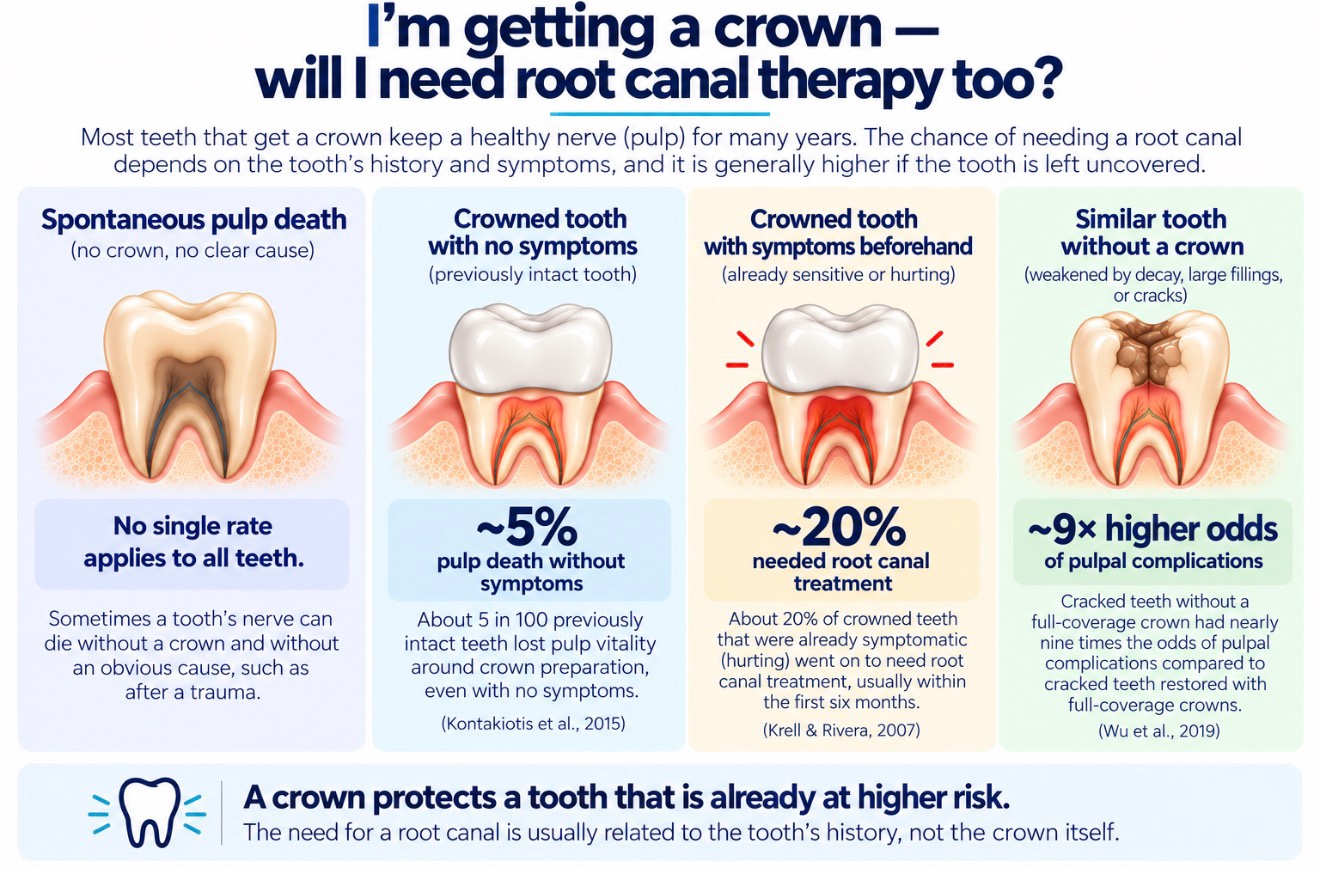
It is one of the more frustrating conversations in dentistry. You invested in a crown to protect a tooth, and months or years later you are told it needs a root canal. It can sound as though the crown caused the problem.
Usually not by itself. A tooth gets a full crown not because it is pristine but because it has been through a great deal, and each of those injuries, decay, large fillings, cracks, leaves what dentists call a stressed pulp. Preparing the tooth can also damage the pulp, and a pulp already weakened by that history may not recover. Some will need root canal treatment even when the crown itself is done well.
How often does this happen?
A 2023 review combining 37 studies found about 5 in 100 crowned teeth developed pulp death. The researchers rated the certainty of that evidence as low, so treat it as an estimate, not a precise figure. [1] Insurance records from 88,409 crown placements agree: about 3.5 in 100 needed root canal treatment, and roughly 9 in 10 had no complication after nine years. [2] Time matters in reading these numbers. Studies that follow teeth longer find more pulp loss: in one study that recalled patients 10 to 19 years after treatment, about 16 in 100 vital single crowns had needed endodontic treatment, and about 33 in 100 bridge retainers. [21] A Tufts chart review found pulpal disease in about 7.5 in 100 crowned teeth, and in the cases where it developed, the median time to diagnosis was 56 days after cementation. [22] Those numbers are averages across all crowned teeth, not a prediction for any one tooth. The risk for a specific tooth depends on its history, which is the rest of this article.
Why does this happen?
The strongest pattern is the tooth’s history. In a 2022 study, teeth restored two or more times before the crown had nearly four times the odds of needing root canal treatment afterward; three or more, nearly six times. [3] A Greek study shows the same divide: intact teeth lost pulp vitality 5% around crown preparation; teeth arriving with decay, fillings, or old crowns, 13%. [4]
Cracks tell the same story. A crown is often placed because a tooth is cracked, and a crack running toward the pulp can inflame it in ways no test detects beforehand; a borderline pulp may never recover. That is not the crown failing; the symptoms come from damage the tooth already had. The depth of any pocket along the crack matters as well: in a study of 182 cracked teeth, pulp necrosis was present in about 11 in 100 teeth with probing depths of 3 mm or less, compared with about 30 in 100 where the pocket along the crack measured 4 mm or more. [19]
Clenching and grinding belong on this list too. Years of heavy bite force flex the cusps and drive the cracks described above, leaving a pulp chronically overloaded. The one direct study, a UCSF master’s thesis of 3,240 patients, found people with signs of bruxism about a third more likely to have had a root canal: a modest link, and so far unreplicated. [13] In the national cracked-tooth registry, clenchers were more likely to have a symptomatic cracked tooth [14], an association found at the time the teeth were examined, not proof that clenching caused the symptoms, and clenching did not predict failure over three years. [10] Two newer studies are worth knowing, and they point in different directions. In a Spanish cohort of 551 root canal treatments, success in otherwise healthy patients was 78% with untreated bruxism versus 93% without it, though the study design limits how much weight that can carry. [17] A randomized trial of 109 single molar crowns in people with sleep bruxism found no difference in crown survival at three years between bruxers and non-bruxers. [18] The narrower, more consistent finding is that heavy bite force worsens outcomes after a tooth has been treated or restored, rather than being proven to damage the pulp of a crowned tooth in the first place. No study has measured the risk for an already crowned tooth; the concern that force could deepen a crack or keep a borderline pulp irritated is reasoning, not a number.
Symptoms beforehand make the point sharpest. The clearest data come from cracked teeth whose pulps were already inflamed but not yet irreversibly damaged when crowned. In an American series gathered over six years, 127 such teeth were crowned without a root canal first, and about 1 in 5 needed one within about six months. [5] A Singapore study of 199 teeth found 29% developed irreversible inflammation or pulp death within three years. [6] Against roughly 1 in 20 for crowned teeth overall [1], a tooth hurting before its crown is several times more likely to need one afterward. One honest caveat: these teeth were cracked as well as symptomatic, and no study cleanly separates the two. A 2026 study of 263 root canal treated cracked teeth found 82.9% success over one to five years; the strongest predictors of failure included a pocket of 5 mm or more along the crack, a crack extending 3 mm or more into the root, and restoring the tooth with an onlay or filling instead of a full crown. [24]
There are risks in acting too early and in waiting too long. When a tooth genuinely needs a crown, the better time is while it is quiet: waiting for pain usually means waiting until the pulp is inflamed and the odds have worsened. But crowning early, just in case, is its own harm: even intact teeth lost pulp vitality 5% around crown preparation [4], so a tooth with no structural need takes on a real risk and solves no problem. The honest middle is to watch a tooth that can safely be watched, and crown it once the need is real, ideally before it starts to hurt.
What if my tooth doesn’t hurt?
The opposite case: a crowned tooth that never hurt, because a pulp can fail quietly. In the Greek study, about 9% of teeth lost vitality between preparation and cementation with no symptoms. [4] A pulp worn by years of decay and repair can decline beneath old fillings before it announces itself. Pain often appears late or not at all, which is why a painless crowned tooth still needs regular checkups.
Recession may contribute as well. Where the gum has pulled back, a thin covering separates the root’s dentin from the pulp, and a crown’s edge finishes near that exposed surface. No study has isolated recession as a risk factor after crowns, so this is reasoning, not a statistic; the nearest data, on gum disease and prosthetic load, found pulp death in 15% of teeth carrying fixed bridgework, versus 3% in teeth not used as supports. [12] A receded gumline usually means the pulp has been under stress for a long time.
And sometimes there is no crown and no clear cause: a hard knock can kill a pulp up to two years later [15], and teeth whose canals calcified after trauma kept failing, 1 in 12 of them in follow-ups as long as twenty-two years. [16] Some teeth would have needed a root canal with or without a crown.
Does the crown procedure itself cause it?
The procedure contributes too, and technique is designed to limit its share. Shaping a tooth removes dentin insulating the pulp, and human pulp studies show injury rising as that layer thins below about half a millimeter; heavily restored teeth have less to spare, part of why their risk runs higher, and preparing conservatively respects that margin. [7] Heat is the clearest example. A 1965 study found a temperature rise of about 5.5°C inside the pulp damaged some teeth, a large part of why preparation is done under continuous water cooling. [8] Cooling keeps that rise small, but it does not make the step risk-free, and a pulp’s response is never fully predictable.
What happens if I skip the crown?
The fair comparison is not crown versus nothing going wrong; it is crown versus leaving a weakened tooth uncovered. A tooth recommended for a crown is structurally compromised: thin, unsupported cusps around a large filling, a crack, heavy wear. Left uncovered, it keeps taking biting force on that structure, and the common result is a cusp breaking off or a crack extending below the gumline, a fracture that cannot be repaired. Not every weakened tooth fails, and some can be watched or restored with a smaller restoration; which approach fits depends on how much sound structure is left.
The starkest numbers come from root canal treated teeth, the most vulnerable group: in a University of Iowa study, teeth never crowned after their root canal were lost at six times the rate of crowned teeth. [9] In the Singapore study, cracked teeth without a full-coverage crown had nearly nine times the odds of pulpal complications. [6] In the US Cracked Tooth Registry (2,858 cracked teeth, three years), teeth given an internal filling rather than a covering restoration failed significantly more often, needing root canal treatment, further treatment, or extraction. [10] A Swedish register study of 343,809 teeth found single crowns survived 92.8% at ten years, compared with 89.1% for extensive direct restorations, and the direct restorations were retreated more often. [20] And in that American series, the other 100 of the 127 teeth had not needed a root canal when the results were reported. [5]
Put plainly, the choice is rarely between a risk and no risk. It is between a small, usually manageable risk with a crown, and a materially higher risk of losing the tooth without one.
What if I need one anyway?
A root canal in a crowned tooth does not usually mean losing the crown: treatment is done through a small opening in the chewing surface, sealed afterward. In a 2022 case series, 153 teeth were treated through existing crowns; among the 127 followed for two to four years, 95.3% had healed and no failure was attributed to the root canal itself. The few losses were from root fractures or new decay. [11] The crown itself fares somewhat worse after being opened: in a matched study of 240 crowns, crowns repaired after a root canal access survived at 85.8%, compared with 91.7% for crowns that were never opened, and heavy bite forces or bite interferences were the only significant predictor of failure in the repaired crowns. [23]
My takeaway as a dentist: a tooth that needs a crown and a tooth at risk of needing a root canal are usually the same tooth. The crown protects the structure; it cannot undo damage the pulp has already sustained. What good care can do is assess the pulp honestly beforehand, prepare it gently, and watch it over time. If a root canal is needed afterward, it is usually completing the tooth’s treatment rather than evidence that the crown failed. Evidence matters. Individual assessment matters. If you have a crowned tooth that has started to feel different, let’s talk.
References
- Al-Manei KK, et al. Incidence and influential factors in pulp necrosis and periapical pathosis following indirect restorations: a systematic review and meta-analysis. BMC Oral Health. 2023. PubMed
- Yavorek A, et al. The incidence of root canal therapy after full-coverage restorations: a 10-year retrospective study. Journal of Endodontics. 2020. PubMed
- Won K, Berlin-Broner Y. Factors associated with the need for a primary endodontic treatment after single-unit crown cementation: a retrospective case-control study. Journal of Endodontics. 2022. DOI
- Kontakiotis EG, et al. A prospective study of the incidence of asymptomatic pulp necrosis following crown preparation. International Endodontic Journal. 2015. PubMed
- Krell KV, Rivera EM. A six year evaluation of cracked teeth diagnosed with reversible pulpitis: treatment and prognosis. Journal of Endodontics. 2007. PubMed
- Wu S, Lew HP, Chen NN. Incidence of pulpal complications after diagnosis of vital cracked teeth. Journal of Endodontics. 2019. DOI
- Murray PE, et al. Remaining dentine thickness and human pulp responses. International Endodontic Journal. 2003. PubMed
- Zach L, Cohen G. Pulp response to externally applied heat. Oral Surgery, Oral Medicine, Oral Pathology. 1965. PubMed
- Aquilino SA, Caplan DJ. Relationship between crown placement and the survival of endodontically treated teeth. Journal of Prosthetic Dentistry. 2002. PubMed
- Ferracane JL, et al. Outcomes of treatment and monitoring of posterior teeth with cracks: three-year results from the National Dental Practice-Based Research Network. Clinical Oral Investigations. 2022. PubMed
- Abusteit OE, et al. Outcome of endodontic treatment through existing full coverage restorations: an endodontic practice case series. Journal of Endodontics. 2022. PubMed
- Bergenholtz G, Nyman S. Endodontic complications following periodontal and prosthetic treatment of patients with advanced periodontal disease. Journal of Periodontology. 1984. PubMed
- Wang S. Does bruxism contribute to root canal treatment? Master’s thesis, University of California, San Francisco. eScholarship (University of California). eScholarship
- Hilton TJ, et al. Correlation between symptoms and external cracked tooth characteristics: findings from the National Dental Practice-Based Research Network. Journal of the American Dental Association. 2017. PubMed
- Andreasen FM, Pedersen BV. Prognosis of luxated permanent teeth — the development of pulp necrosis. Endodontics and Dental Traumatology. 1985. DOI
- Robertson A, et al. Incidence of pulp necrosis subsequent to pulp canal obliteration from trauma of permanent incisors. Journal of Endodontics. 1996. PubMed
- De la Rosa Rico A, et al. Influence of untreated bruxism on root canal treatment outcome: a retrospective cohort study of 551 patients. BMC Oral Health. 2026. DOI
- Bömicke W, et al. Ceramic crowns and sleep bruxism: 3-year results of a randomized controlled trial. Journal of Dentistry. 2026. PubMed
- Yang SE, et al. Analysis of the characteristics of cracked teeth and evaluation of pulp status according to periodontal probing depth. BMC Oral Health. 2017. PubMed
- Olander J, et al. Long-term clinical outcomes for single dental crowns versus extensive direct restorations: a register-based cohort study with up to 10 years of follow-up in a Swedish population. Journal of Dentistry. 2026. PubMed
- Cheung GSP, Lai SCN, Ng RPY. Fate of vital pulps beneath a metal-ceramic crown or a bridge retainer. International Endodontic Journal. 2005. PubMed
- Ptak DM, et al. The pulpal response to crown preparation and cementation. Journal of Endodontics. 2023. DOI
- Sinkanarak P, et al. Survival outcomes of crowns with and without repaired endodontic access cavities: a retrospective propensity score matching study. European Endodontic Journal. 2025. PubMed
- Wongkornchaowalit N, et al. Treatment outcomes and prognostic analysis of root canal-treated posterior cracked teeth: the Modified Iowa Index. Journal of Endodontics. 2026. PubMed